
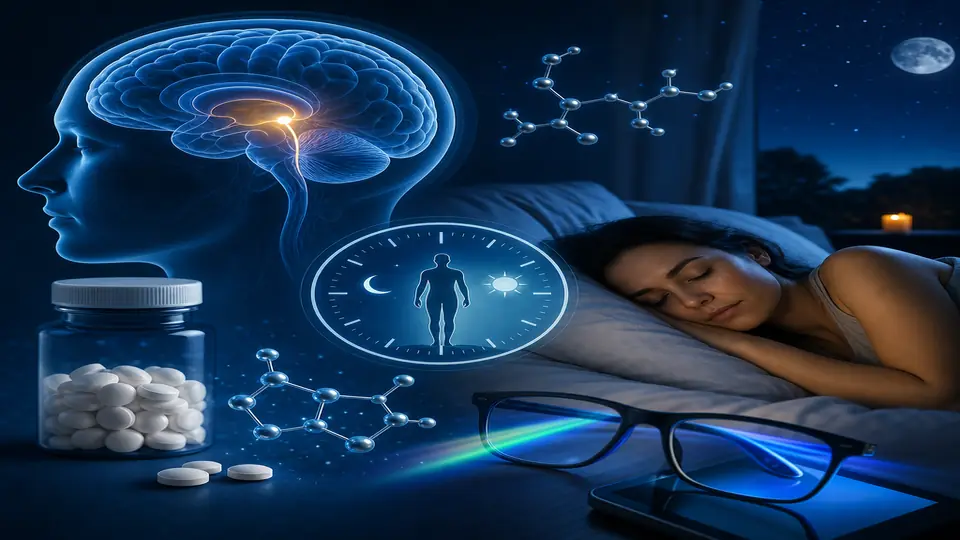
At a Glance
| Parameter | Details |
|---|---|
| Mechanism | Pineal hormone; MT1/MT2 receptor agonist; mitochondrial antioxidant |
| Physiological dose | 0.2–0.5 mg (mimics natural secretion) |
| Sleep-onset dose | 0.5–3 mg taken 60–90 min before bed |
| High-dose range | 5–20 mg (specific clinical indications only) |
| Peak blood level | ~60–120 min post-ingestion (immediate-release) |
| Half-life | 40–60 min (immediate-release) |
| Best form | Immediate-release for sleep onset; extended-release for sleep maintenance |
| Key interactions | Warfarin, immunosuppressants, benzodiazepines, diabetes medications |
| Safety grade | High at physiological doses; caution with chronic high-dose use |
Melatonin is simultaneously one of the most widely used supplements in the world and one of the most consistently misused. Walk into any pharmacy and the default offering is 5–10 mg — doses that dwarf what the healthy pineal gland actually produces. That mismatch matters: the research showing meaningful benefit at pharmacological doses is largely confined to specific clinical contexts, while the everyday sleep and circadian complaints most people bring to my clinic respond best to doses ten times smaller.
This guide covers what melatonin actually does in the body, how to match the dose and form to the goal, which patient populations benefit most, and what the emerging longevity and immune biology tells us about this ancient hormone.
How the Body Makes and Uses Melatonin
Melatonin (N-acetyl-5-methoxytryptamine) is synthesised from serotonin in the pineal gland, with synthesis gated almost entirely by the absence of light hitting the retina. The suprachiasmatic nucleus (SCN) of the hypothalamus — the master circadian clock — drives pineal secretion through a noradrenergic pathway. Light exposure, especially in the blue-wavelength range (460–480 nm), acutely suppresses melatonin within minutes.
In a healthy adult sleeping in genuine darkness, melatonin begins rising about two hours before habitual sleep onset (the “dim-light melatonin onset,” or DLMO), peaks somewhere between 2 and 4 AM at concentrations of 100–200 pg/mL, and then falls sharply before wake time. By afternoon, circulating melatonin is nearly undetectable.
What is less widely appreciated is that melatonin acts on virtually every tissue in the body. MT1 and MT2 receptors are expressed in the brain, retina, cardiovascular system, gastrointestinal tract, immune cells, bone marrow, and reproductive organs. Beyond receptor signalling, melatonin is also a direct free-radical scavenger — and uniquely, it penetrates mitochondria and cell nuclei, where most antioxidants cannot reach.
Age-Related Decline
Melatonin production drops substantially with age. By the time a person reaches their sixties, nocturnal peak melatonin may be only 20–30% of youthful levels. This decline correlates with sleep fragmentation, reduced immune surveillance, increased oxidative stress, and accelerated cellular ageing — although causality is difficult to establish from epidemiology alone. Still, restoring physiological melatonin concentrations in older adults is one of the more rational supplementation strategies in my practice.
Dose: Why Less Is Usually More
The dose-response curve for melatonin is unusual. Unlike most drugs and supplements where more consistently produces more effect, exogenous melatonin at high doses can desensitise MT1/MT2 receptors, suppress endogenous production, and alter circadian phase in unintended directions.
Physiological Range (0.1–0.5 mg)
This range most closely mimics endogenous nocturnal concentrations. Several well-designed crossover trials have shown that 0.3–0.5 mg taken 60–90 minutes before desired sleep onset reduces sleep-onset latency comparably to 5 mg — and with substantially fewer next-morning grogginess or vivid-dream complaints. This is the range I recommend as a starting point for virtually all patients using melatonin for circadian alignment or mild sleep-onset difficulty.
Standard Supplemental Range (1–3 mg)
This is appropriate for: jet lag protocol (explained below), shift workers whose sleep is severely fragmented, and patients with documented DLMO delay on salivary testing. At these doses, clinical benefit is well-documented and tolerability remains high for most individuals.
High-Dose Range (5–20 mg)
Reserved for specific clinical contexts:
- Oncology support: Melatonin at 10–20 mg is used adjunctively in some integrative oncology protocols, where its anti-proliferative and immune-modulatory properties are clinically relevant.
- Traumatic brain injury and neurosurgery recovery: High-dose melatonin has antioxidant and anti-inflammatory properties that may be neuroprotective in acute injury.
- Cluster headaches: 10 mg at night has evidence from small RCTs for cluster headache prophylaxis.
- Severe DSPD (Delayed Sleep Phase Disorder): Sometimes requires 5 mg to produce phase advance in non-responders to lower doses.
Chronic high-dose use (5 mg or more nightly) without a specific clinical indication is, in my view, not justified by current evidence and carries theoretical risk of receptor downregulation.
Timing Is as Important as Dose
Getting the timing right amplifies efficacy more than increasing dose does. The goal is to align supplemental melatonin with the natural rise of the DLMO.
For sleep-onset difficulty: Take 0.3–1 mg approximately 60–90 minutes before your target bedtime. Do not take it at the moment you are trying to fall asleep — by then, the window for circadian signalling has passed and you are relying on a sedative effect that melatonin does not reliably produce.
For jet lag (eastward travel): Begin taking 0.5–3 mg at the destination’s target bedtime for three to five days starting on the day of arrival. For westward travel, the evidence for melatonin is weaker; it is most useful for advancing sleep phase, not delaying it.
For shift work: This is clinically complex and individual. The general principle is to take melatonin at the beginning of the intended sleep window regardless of clock time.
For night waking (sleep maintenance): Immediate-release melatonin is largely metabolised before the second half of sleep. Extended-release formulations or a low-dose second dose (0.3 mg) upon waking between 2–4 AM may help, though evidence is limited.
Forms and Formulations
| Form | Onset | Duration | Best For |
|---|---|---|---|
| Immediate-release | 30–60 min | 4–5 h | Sleep onset, jet lag |
| Extended-release | 60–90 min | 8–10 h | Sleep maintenance, older adults |
| Sublingual/liquid | 15–30 min | 3–4 h | Faster onset, flexible dosing |
| Transdermal patch | Variable | 6–8 h | Sustained release, GI sensitivity |
Sublingual formats are my preference for physiological-dose use because absorption bypasses first-pass hepatic metabolism, reducing the dose needed to achieve circulating levels comparable to oral tablets at higher doses.
Avoid melatonin products with added ingredients (valerian, 5-HTP, GABA) unless you specifically want those co-ingredients — they make it impossible to titrate melatonin alone and can cause their own side effects.
Benefits Beyond Sleep
1. Mitochondrial Antioxidant
Melatonin is among the few small molecules that accumulate inside mitochondria. There, it scavenges reactive oxygen species (ROS) directly and upregulates superoxide dismutase (SOD) and glutathione peroxidase. In the context of ageing, chronic infection, and inflammatory conditions — all of which I see in my patient population — this mitochondrial protection is arguably melatonin’s most clinically significant non-sleep effect.
A useful analogy: NAD+ fuels the mitochondrial electron transport chain; melatonin neutralises the inevitable oxidative exhaust. The two are synergistic, and I often use them together in longevity protocols.
2. Immune Modulation
Melatonin exerts complex bidirectional effects on immunity — stimulating innate immunity at physiological concentrations while down-regulating excessive inflammatory signalling. NK cell activity, macrophage function, and Th1/Th2 balance are all influenced by MT1/MT2 receptor activity on immune cells. Several studies in older adults show that low-dose melatonin supplementation restores age-associated NK cell deficits, which is relevant to both infection surveillance and tumour immunology.
3. Cancer Biology
This is the most compelling and least discussed area of melatonin research. Epidemiological data consistently links overnight light exposure (which suppresses melatonin) with elevated breast, prostate, and colorectal cancer risk. Mechanistically, melatonin:
- Inhibits telomerase in some tumour cell lines
- Reduces oestrogen receptor signalling in oestrogen-sensitive breast cancer
- Activates p53-mediated apoptosis in certain cancer cells
- Modulates the tumour microenvironment via immune cell regulation
High-dose melatonin (10–20 mg) has been studied as an adjunct to chemotherapy in several Phase II trials, with modest but real improvements in response rate and quality-of-life metrics. I discuss this with appropriate patients in an integrative oncology context, clearly distinguishing it from primary therapy.
4. Neuroprotection
Melatonin crosses the blood-brain barrier freely. It reduces neuroinflammation via NF-κB inhibition, protects against beta-amyloid toxicity in animal models of Alzheimer’s disease, and reduces markers of oxidative neuronal damage in traumatic brain injury. Clinical translation remains incomplete, but the mechanistic rationale for including melatonin in protocols for brain fog, post-viral neuroinflammation, and cognitive ageing is sound.
5. Cardiovascular Effects
Lower melatonin levels correlate with higher nocturnal blood pressure and increased cardiovascular event risk in epidemiological studies. Supplementation at 2–5 mg in hypertensive patients has shown modest reductions in nocturnal systolic blood pressure in controlled trials. The mechanism likely involves MT1-mediated vasodilation and reduction of sympathetic tone during sleep.
Who Benefits Most
Older adults (60+): Declining endogenous production makes physiological-dose supplementation particularly rational. Start at 0.3–0.5 mg.
Shift workers and frequent travellers: Melatonin is the best-evidenced intervention for circadian phase shifting. Dose 0.5–3 mg timed to target sleep onset.
Post-COVID and chronic fatigue patients: Melatonin’s mitochondrial antioxidant properties and sleep architecture benefits make it a standard inclusion in my post-infectious recovery protocols.
Patients on chemotherapy: Discuss with the treating oncologist; melatonin has shown safety and some benefit as an adjunct in multiple RCTs.
Individuals with screen-heavy lifestyles: Blue-light suppression of endogenous melatonin is pervasive. Either use blue-light blocking glasses 1–2 hours before bed, or supplement with 0.3–0.5 mg to compensate.
Drug Interactions and Safety
Melatonin is generally safe at physiological doses. Key interactions to know:
- Warfarin / anticoagulants: Melatonin may potentiate anticoagulant effect; monitor INR.
- Immunosuppressants: High-dose melatonin is immunostimulatory — relevant for transplant patients.
- Benzodiazepines / Z-drugs: Additive CNS depression; avoid combining or use with caution.
- Diabetes medications: Melatonin influences insulin secretion via MT1 receptors in pancreatic beta cells; monitor glucose.
- CYP1A2 inducers/inhibitors: Melatonin is metabolised by CYP1A2; fluvoxamine (inhibitor) substantially raises melatonin levels; smoking and rifampicin reduce them.
Side effects at physiological doses are rare. At doses above 3 mg: next-day drowsiness, vivid dreams, headache, and paradoxical alertness in sensitive individuals. Reproductive hormones may be affected with very high chronic doses (theoretical concern based on animal data; not established in humans at supplemental doses).
Autoimmune conditions: Exercise caution with high-dose melatonin in autoimmune disease — its immunostimulatory effects could theoretically worsen inflammatory flares.
My Clinical Protocol
In practice, my default melatonin protocol for a new patient with sleep-onset difficulty and age-related circadian drift:
- Confirm light hygiene first — no bright overhead lighting or screens after sunset, or blue-light glasses from 8 PM.
- Start at 0.3 mg sublingual, 90 minutes before target sleep time.
- Assess at 2 weeks: if sleep-onset is improved, stay at 0.3 mg. If partial response, increase to 0.5–1 mg.
- For older adults or post-COVID patients: add to NAD+ protocol and consider extended-release at 1–2 mg.
- For oncology-adjacent use: discuss with the patient’s oncologist and typically use 10 mg immediate-release at night, with documented informed consent about the investigational nature.
Related Articles
- NAD+ IV Therapy: What to Expect and How It Works
- Magnesium for Sleep: Which Form Works Best
- Sleep Supplement Stack: A Physician’s Evidence-Based Guide
- DSIP vs Melatonin: Comparing Two Sleep Peptides
- Circadian Rhythm Optimisation for Longevity
References
-
Lewy AJ, et al. “Low, but not high, doses of melatonin entrained a free-running blind person with a long circadian period.” Chronobiol Int. 2002;19(3):649–658. PMID: 12069043
-
Brzezinski A, et al. “Effects of exogenous melatonin on sleep: a meta-analysis.” Sleep Med Rev. 2005;9(1):41–50. PMID: 15649737
-
Reiter RJ, et al. “Melatonin as an antioxidant: under promises but over delivers.” J Pineal Res. 2016;61(3):253–278. PMID: 27500468
-
Lissoni P, et al. “A phase II study of tamoxifen plus melatonin in metastatic solid tumour patients.” Br J Cancer. 1996;74(9):1466–1468. PMID: 8893477
-
Schernhammer ES, Laden F, Speizer FE, et al. “Rotating night shifts and risk of breast cancer in women participating in the Nurses’ Health Study.” J Natl Cancer Inst. 2001;93(20):1563–1568. PMID: 11604480
-
Markus RP, et al. “Immune-pineal axis: nuclear factor κB (NF-κB) mediates the shift in the melatonin source from pinealocytes to immune competent cells.” Int Immunopharmacol. 2013;17(2):419–423. PMID: 23731670
-
Zisapel N. “New perspectives on the role of melatonin in human sleep, circadian rhythms and their regulation.” Br J Pharmacol. 2018;175(16):3190–3199. PMID: 29318587